How exclusion shapes meetings before it shapes outcomes
In the Cyberball experiment, developed by psychologist Kipling Williams, participants believe they are taking part in a simple online ball game with two or three other players. In reality, the other players are computer-generated.
At the beginning, the game feels normal. Everyone receives the ball equally. Then, after a short period, the participant is excluded. The other players continue passing the ball to each other but stop passing it to the participant.
Just a few seconds after the exclusion, researchers observed clear neurophysiological reactions associated with physical pain in the participants. Social exclusion was shown to affect four basic human needs: belonging, self-worth, control, and purpose. In cases of prolonged exposure, long-term consequences such as difficulties with emotional regulation, excessive adaptation, withdrawal, frustration, and depression can occur.
Much of today’s communication is one-way, isolated, and silent. In organisations, on social media, and in politics, one-sided communication has been amplified by technology, and the way we use it.
This one-sided dynamic is not only uncomfortable and unhealthy for the one who is not being passed the ball, but also for the one who is passing the ball and receives no response. Because where no real interaction, interest, and therefore connection are built, there is a lot of room for interpretation, assumptions, and doubts.
In an organisational context, the suffering caused by not being passed the ball affects more than human needs. We know from research that productivity, effectivness and performance drops when basic needs are not met.

Let’s have a look at a few possible variations and effects of exclusion in meetings and the organisational context.
Shooting the ball at someone doesn’t help
When the ball has been passed around for a long time and all of a sudden someone shoots the ball hard at you out of nowhere – that doesn’t necessarily feel safe.
And yet sometimes we do it because we become aware of the dynamic. We don’t want to exclude, and we are genuinely interested in that person’s input.
However, at this point, many people have already switched off. They don’t feel ready, or safe, to share.
>People don’t want to play anymore
“I voiced an idea, but it wasn’t given any consideration. Every new idea is treated as a problem, so I stopped sharing.”
You may know this situation from either side.
You throw the ball and all you get back is: “Nothing else to add.” “Everything has already been said.” It can also feel frustrating and demotivating for the person who is throwing the ball.
If people no longer want to play, a dynamic of exclusion may already have occurred. And yet the reasons why someone doesn’t want to play are as diverse as we are. They range from fear of embarrassment to simply having a bad day.
Withholding the ball from others is not going to make you win
That moment when someone is holding on to the ball in a soccer game. Everyone shouts, “Pass, pass!” but the player just keeps running and, in the end, often loses the ball.
We may withhold information intentionally or subconsciously to make ourselves look better, to gain an advantage, or to deny others the goal.
That, too, is social exclusion that goes both ways. First against others, but eventually against ourselves, because we exclude ourselves from the team and from the opportunity of the ball being passed back to us.
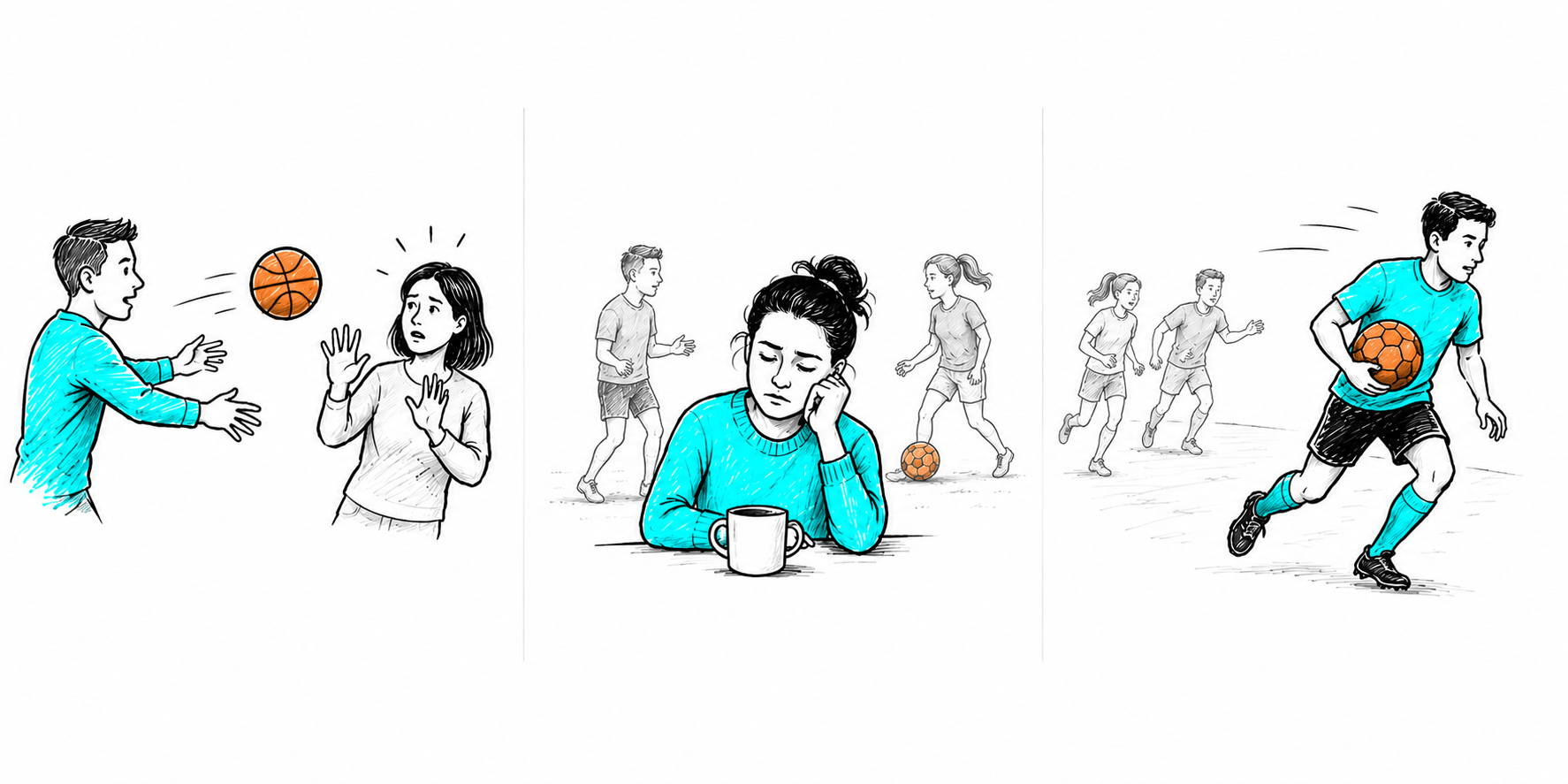
There is no one answer for how to act in any of the above situations because human dynamics are complex, situations are unique, and not every moment requires the same action. But awareness is a great starting point.
Three practical ways to include more
Focus on small groups: 2-4 people
The more people there are, the harder it becomes to pass the ball around. Smaller groups naturally create more opportunities for participation and connection.
Create a new “final round”
We all know the final round of “Any more comments?” in a meeting, passing the ball, even addressing everyone personally. Rarely does any additional thought come in at that point.
Alternatively, the round could be reflective.
Some people require a moment before they can contribute to a group. Let’s say two minutes with these questions. This also gives the opportunity to end on a common direction and understanding.
- A clarity I gained today is…
- A question I am still holding is…
- One thing I appreciate is…
Acknowledge the speaker
In some meetings, we are the dedicated listeners, and that is okay.
As mentioned earlier, silence can not only be uncomfortable for the listener. If you are the speaker, silence on the listener’s end can also be very disengaging.
Playing is a two-way street, even when it is agreed that one person is holding the ball.
How can you make an effort to acknowledge someone’s existence? To show that you see and hear what the other person is saying?
A comment in the chat. A short opening of the microphone. Eye contact. A gesture.
Productive, engaging, and effective meetings are about structure. The first layer of structure is inclusion.
We have created a training field for dialogue, inclusion, and peer-to-peer learning – Leadership Spectrum Online. On the 30th June at 4pm CET we will hold an open and informal online meeting – “Leadership Spectrum – Meet the team”. Send a message to welcome@marina-and-team.com if you would like to join & explore the “good future” together with us
Let’s talk team!


